Article by Phoenix Writer Mary O’Brien ’27
Less than a week after I had flown home from Ben Gurion Airport in Tel Aviv, missiles were being fired by the United States, Israel and Iran across the Middle East.
Over the Winter Break, I journeyed to Israel with five other Catholic students from Kellenberg and four Jewish students, with the intention of gaining a deeper knowledge and understanding of my own faith and that of others.
A sacred place rich in both Christian and Jewish traditions, we spent 10 days in the Holy Land together, four of which were in Jerusalem, which is divided into the Jewish quarter, the Christian quarter, the Muslim quarter, and the Armenian quarter.
Unlike the news and media might make us believe, this city does not live in constant conflict. Instead, these people’s daily lives are spent in community with one another through peace and acceptance. While we were standing at the Western Wall, the remains of the second temple complex built by King Herod, we could hear Jewish people praying to God in Hebrew at their most holy site. In addition, we could hear the bells of a Lutheran church ringing, signaling the start of Mass. Then, the Muslim call to prayer could be heard in Arabic over a loudspeaker. Pope Francis articulated: “God is for everyone, and therefore, we are all God’s children.” It was so beautiful to see the three major Abrahamic religions all worshipping God at the same time.
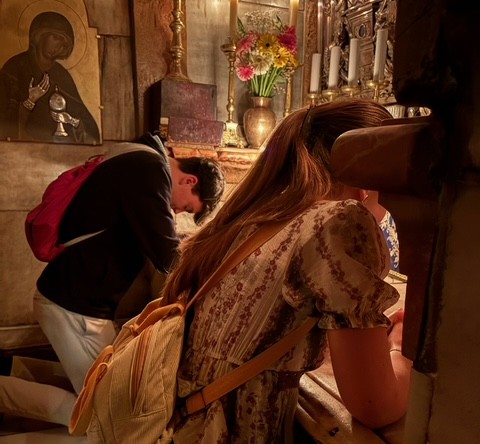
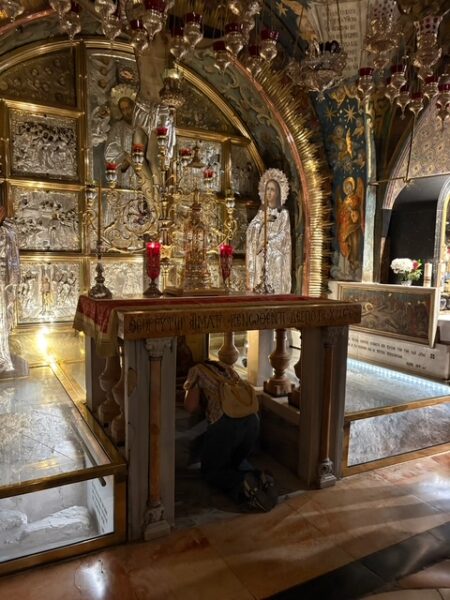 In addition, we had Mass together and journeyed to many Catholic sites, including the Church of the Holy Sepulchre, where everyone had the opportunity to kneel and touch the stone where Jesus died on the cross to save humanity. We also touched and prayed upon the stone where Jesus’ body was anointed for burial by the Blessed Mother. One of the most impactful experiences of this mission was entering the tomb where Jesus was buried, where he rose from the dead. I could feel the presence and Glory of God surrounding me. I felt blessed to be in this holy place. We visited the Upper Room, where Jesus instituted the Eucharist at the Last Supper and where the Holy Spirit later descended upon the Apostles, granting them the wisdom to spread the Gospel. We went to the Church of the Agony in the Garden. We touched the rock where Jesus prayed to God, His Father.
We also entered the Church of the Beatitudes, where Jesus gave the Sermon on the Mount, presented us with the beatitudes and the Lord’s Prayer. This beautiful church is surrounded by a balcony and a garden overlooking the Sea of Galilee. On Ash Wednesday, we visited the Church of the Annunciation, where Mary gave her Fiat, or yes, to God, and agreed to give birth to the Messiah. This was the beginning of Jesus’ life, because at this moment he was conceived in His mother’s womb.
To honor Jewish tradition, as Jesus would have 2000 years ago, we celebrated Shabbat together twice. As a group, we traveled to Yad Vashem, Israel’s memorial institution to the victims of the Holocaust. Its mission is to preserve the memory of the Jews who were murdered, those who fought against their Nazi oppressors, and the stories of the survivors. It also commemorates Gentiles who aided Jews in need. Walking through Yad Vashem in Israel with my Jewish friends was extremely impactful, and it is an experience I will never forget.
On our last day in Israel, we visited Hostage Square in Tel Aviv. This heartbreaking memorial commemorates the 251 innocent people who were kidnapped on October 7th, 2023. At least 85 hostages were murdered in the Gaza Strip. The horror of this present reality and the Gaza War became extremely clear to me in Hostage Square, as did the need for peace. 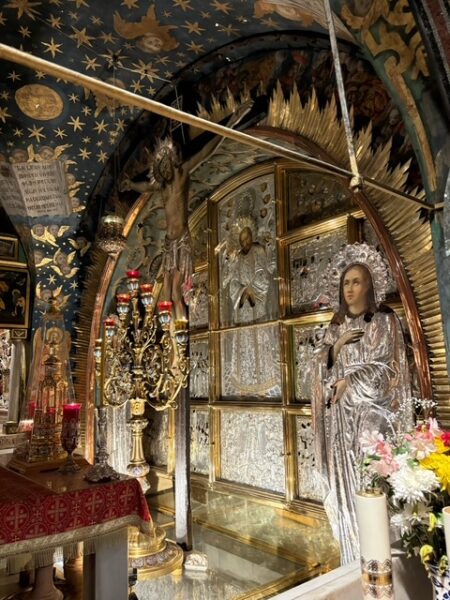
Since the beginning of the trip to Israel, I had been constantly praying for peace in our world. Traveling to Yad Vashem and Hostage Square made me more aware of how important this is. It is our responsibility as followers of Christ to work towards peace between all people, and this cannot be accomplished without prayer. Hate stems from a lack of familiarity with other cultures and religions. The most effective way to stop hate is through education and interfaith dialogue. Pope Francis offered us these words of wisdom: “In order to dialogue, it is necessary to know how to lower the defenses, open the doors of the house, and offer human warmth.” This trip taught me how to defend the Catholic faith–by listening to and praying for others. I have gained a deeper understanding of the Jewish faith and current conflicts in the Middle East. Now, I have a group of faithful Catholic and Jewish friends. We are all working to grow closer to God and to peace, even if we do this differently.
So, how will they know us as Christians? By the way we communicate. By the way we speak and listen. By the way we pray for peace and strive to end conflict peacefully. By the way we love all of God’s children, regardless of differences–through peace, not conflict.
This is our most recent article in our new How Will They Know Us (HWTKU) series. The inspiration is from observations of Christian love in our world. If you would like to know more about this series of articles, please read here.